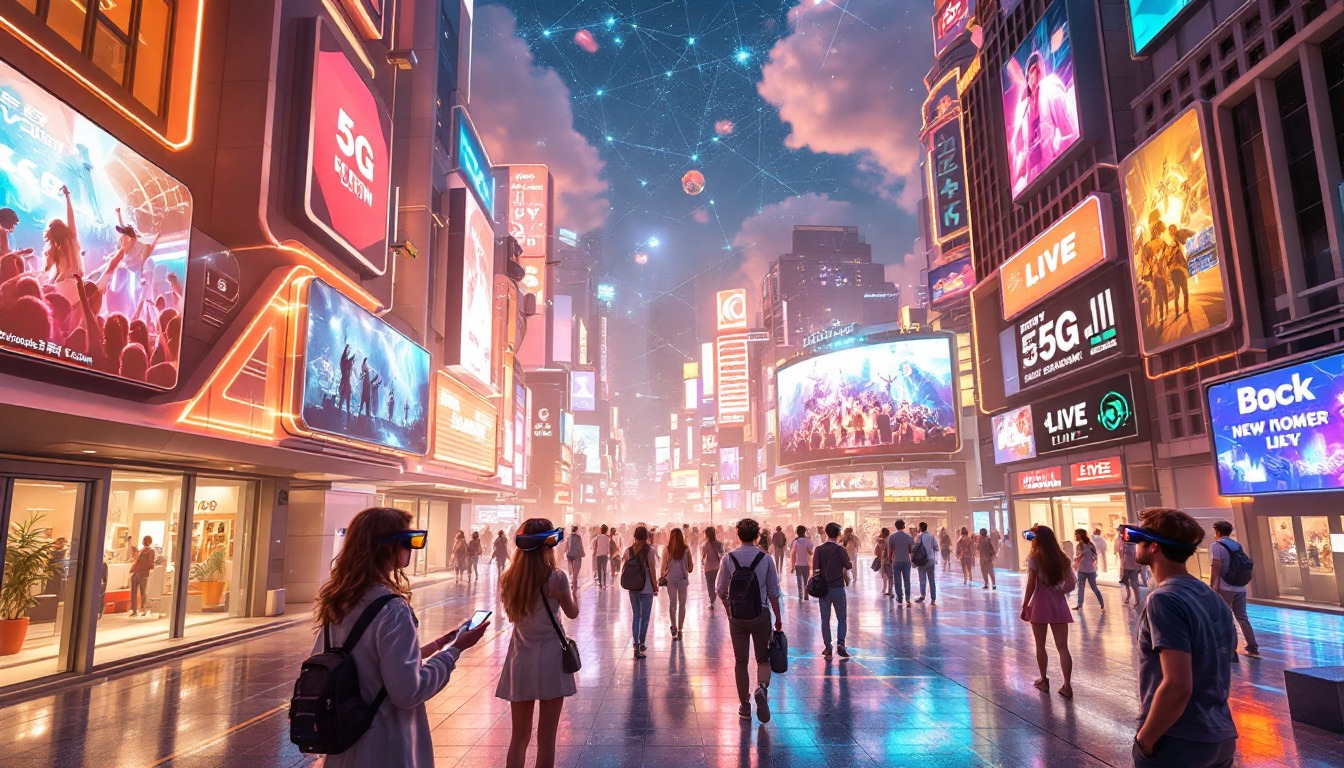
From Static to Dynamic: How 5G is Reshaping Digital Entertainment
Reducing latency: Enhancing Real-Time Interactivity
One of the most significant advantages of 5G is its ability to drastically reduce latency. Traditional networks often experience delays that disrupt real-time interactions, posing challenges for gaming, live streaming, and interactive media. In contrast, 5G networks can achieve latencies as low as 1 millisecond, enabling near-instantaneous communication between users and digital platforms.
This reduction in latency is particularly beneficial for gamers, eliminating lag in highly immersive multiplayer environments and allowing for split-second precision. Live-streaming platforms also benefit, as they can deliver uninterrupted, high-quality video feeds, ensuring smoother broadcasts for events ranging from concerts to sports matches. For instance, during Taylor Swift’s Eras Tour, fans at stadiums set new records for data usage, with AT&T’s network moving 28.9 terabytes of data during the busiest day at AT&T Stadium, highlighting the demand for seamless live-streaming experiences.
Accelerating VR and AR Adoption
The high bandwidth and reliability of 5G are propelling the adoption of virtual reality (VR) and augmented reality (AR) technologies, which are among the new technologies elevating the gaming experience. These immersive experiences require substantial data processing and real-time communication between devices and servers, demands that 4G networks struggled to meet.
With 5G, users can explore richly detailed virtual worlds without the need for bulky equipment, as cloud-based VR offloads computational tasks to remote servers. This advancement is crucial for industries like gaming, education, and healthcare, where VR applications are expanding rapidly. Similarly, AR applications benefit from 5G’s capability to overlay digital elements onto the real world in real time, enhancing experiences in shopping, tourism, and interactive learning. For example, users can virtually try on outfits in retail stores or visualize home furniture layouts through AR apps with flawless responsiveness.
Delivering Seamless User Experiences
Perhaps the most noticeable impact of 5G is its ability to provide seamless user experiences. Consumers now expect instant access to high-quality content, and 5G facilitates streaming of 4K or even 8K videos without buffering. Streaming platforms like Netflix and Disney+ are optimizing their services for 5G-enabled devices, offering consumers uninterrupted entertainment on the go.
Additionally, 5G enables the growth of connected devices and smart environments, seamlessly integrating entertainment into our daily lives. Smart TVs, augmented reality glasses, and other IoT devices can collaborate to create personalized, multi-sensory experiences. Imagine attending a concert virtually, with spatial audio and haptic feedback synchronized perfectly to replicate the atmosphere of being there in person.
Conclusion
The transition from static to dynamic entertainment is well underway, with 5G serving as a catalyst for innovation. By reducing latency, enabling VR and AR adoption, and delivering seamless user experiences, 5G is unlocking a world of opportunities for creators and consumers alike. As 5G networks become more widespread, the boundaries between the physical and digital worlds will continue to blur, evolving entertainment into an ever-present, interactive dimension of our daily lives.
Post a comment